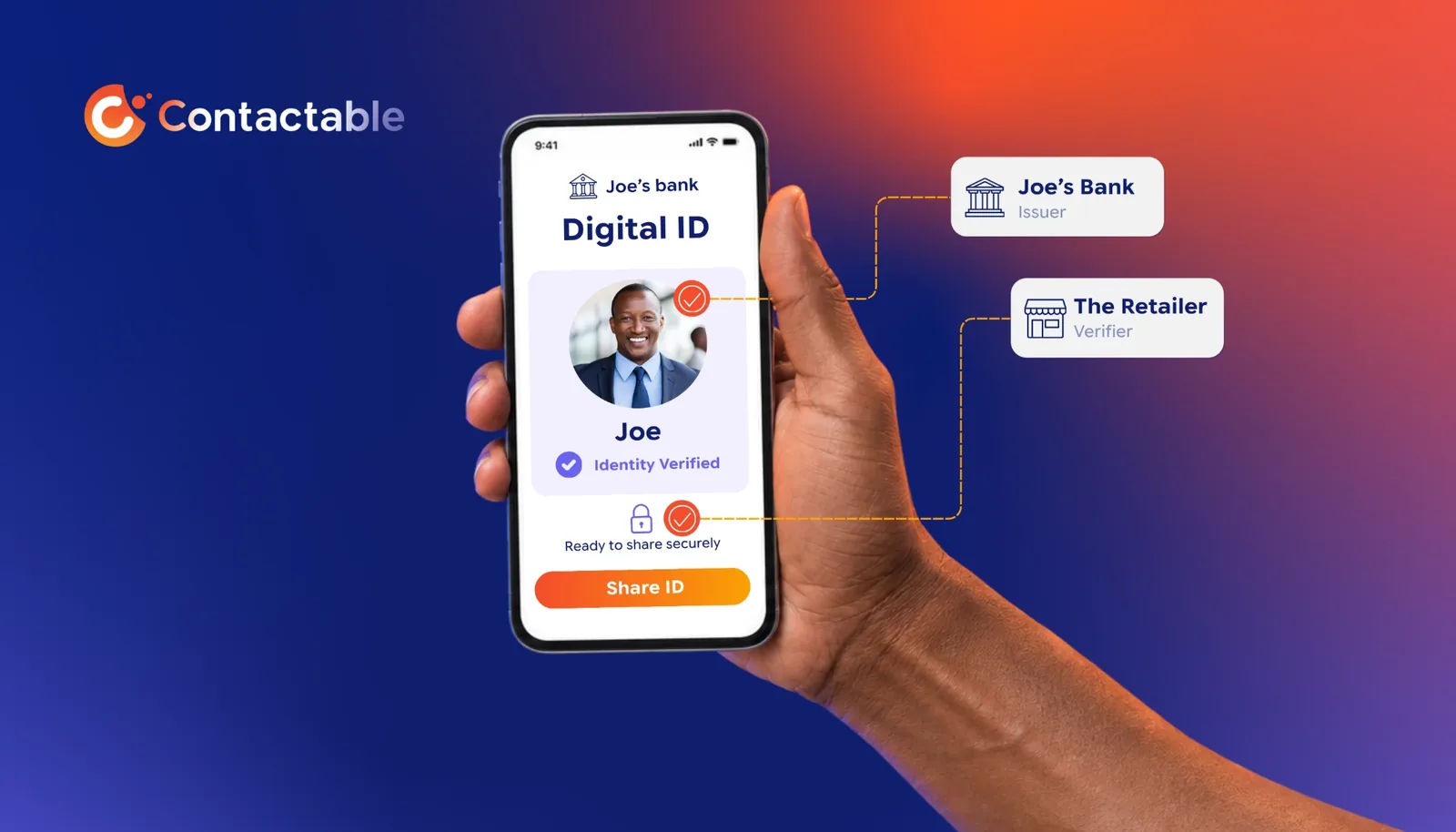
KYC isn’t going anywhere. The repetition is.
I run an identity company, and I still photograph my ID on my kitchen table several times a year. A new account here, a policy there, a store card. We all have good reason to ask why we need to keep supplying the same evidence, again.
Organisations have become very good at asking the same question faster. The opportunity now is to make the answer reusable. Every repeat request gives the customer another job and the business another check and process to pay for.
That’s why I say, “Trust that doesn’t travel is trust you pay for twice.” Because a new relationship needs a new decision. It should not automatically require new evidence.
What a verifiable credential actually is
A verifiable credential is simply trusted digital evidence that can travel with the customer.
Let’s take Joe. He applies for a store account. His bank has already verified who he is, so instead of sending the retailer another copy of his ID, he approves a request to share his ID credential his bank issued. The retailer still decides whether to trust that evidence and what additional checks it needs to perform.
The bank issues. Joe holds. The retailer verifies.
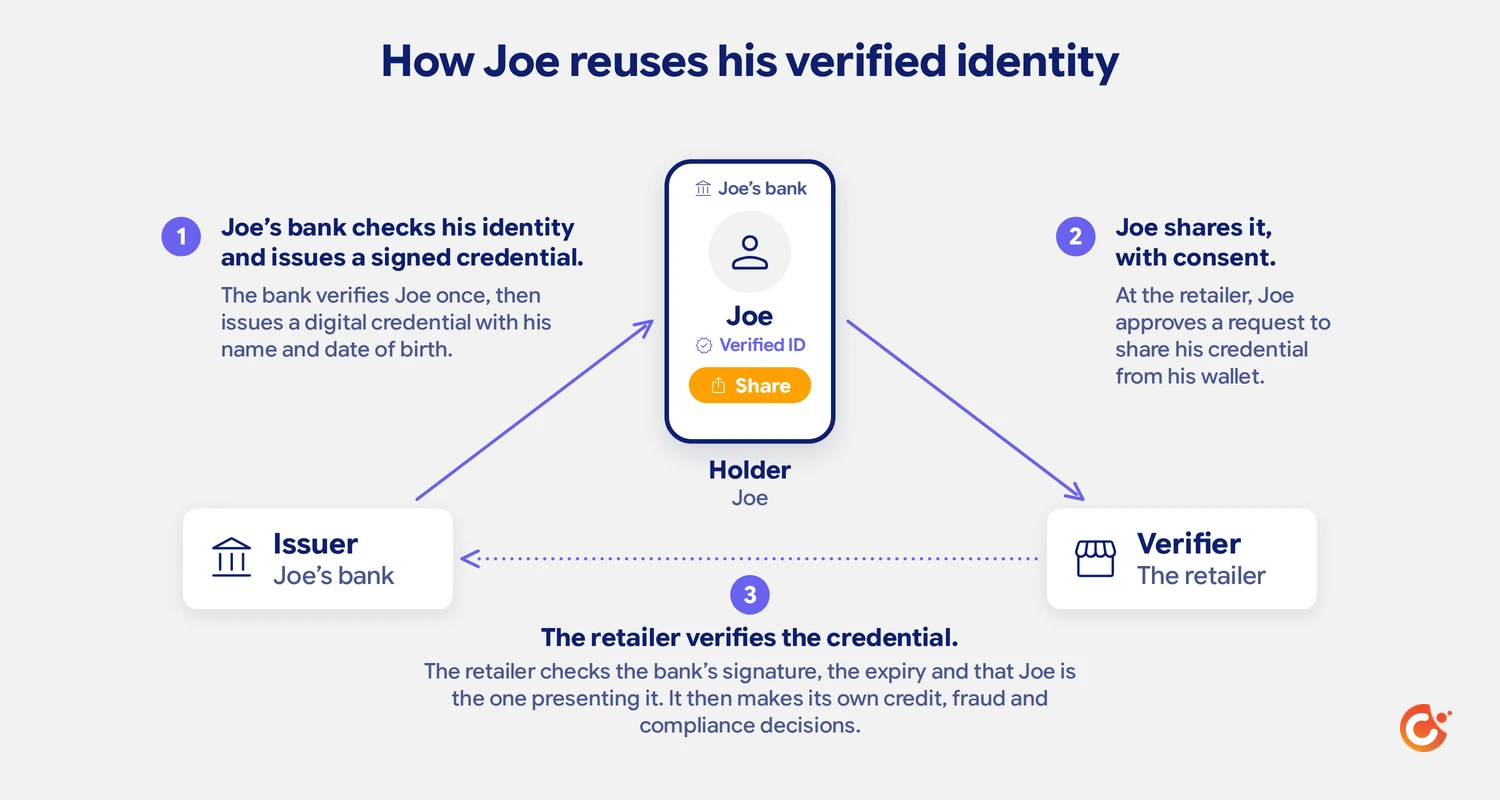
That changes the model. The customer is no longer starting from zero every time, and the business is no longer forced to repeat work someone else has already done.
Credit bureaux already work on a version of this principle: businesses make decisions using evidence collected elsewhere. A verifiable credential puts that signed and trusted evidence in the customer’s hands.
Verify the credential, not the documents.
It is already moving
LinkedIn already runs a version of this: employees at participating companies prove where they work with a credential issued by their employer. A narrow claim, but signed evidence moving between organisations, today. Closer to home, Ethiopia’s central bank now requires the national digital ID to open a bank account, Rwanda replaces its ID card with a single digital identity by mid-2027, and Zambia is targeting digital IDs by the end of this year. South Africa’s digital public infrastructure roadmap has digital payment credentials and wallets scheduled for testing this year, and the Reserve Bank’s payments modernisation is heading the same way, so the credential that proves who you are will sit beside the one that moves your money.
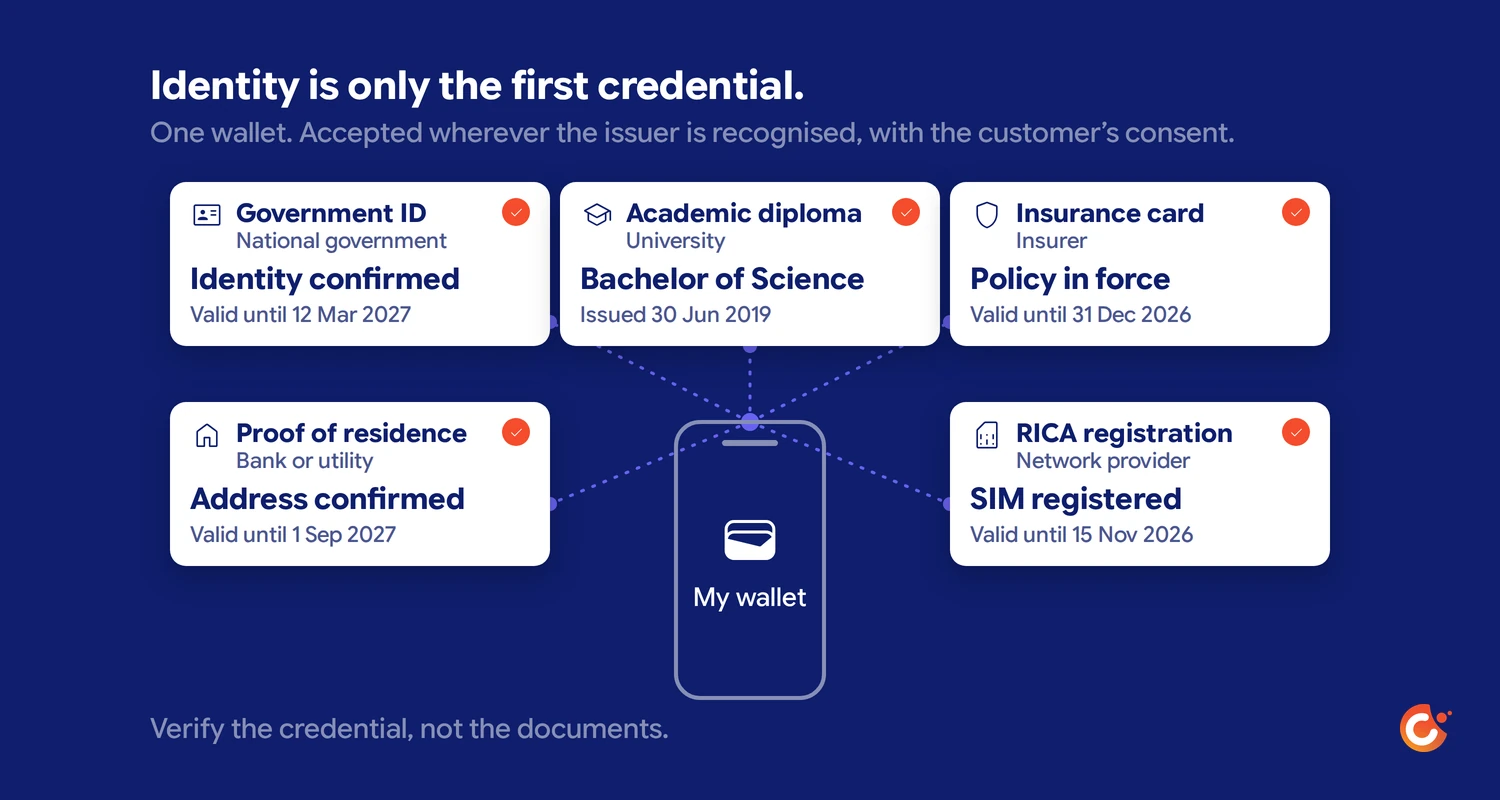
Identity is only the first use. The same wallet could hold proof of account ownership, insurance cover or business registration, and give the customer the ability to digitally RICA a SIM.
Start inside your own business
I would start with an uncomfortable exercise. Follow one customer across your products and count every time your business asks them to prove a fact it already holds. Bring that number to your next budget meeting.
“The most avoidable cost in South African KYC isn’t fraud. It’s repetition. And we’ve spent a decade making it faster instead of making it stop.”
Some repeats will have a sound reason. Others exist because two systems do not share information. Fix those first. Then accept credentials others have issued before you think about issuing your own. You do not need to build a wallet. You need channels that can accept one. Once your own evidence travels too, consented data sharing stops being a cost you carry and becomes something you can offer.
A customer’s circumstances can change, credentials expire and due diligence continues. None of that makes every repeat request necessary.
I will make a prediction. Within five years, “please upload your ID” will sound as dated as “please fax your proof of residence”.
Ask your teams this:
- Operations: which requests repeat work we have already done, and what does that cost us?
- Risk: whose evidence would we accept, and when would we need to check again?
- Technology: could our channels receive and verify a credential?
Your customer wants to prove it once. Your CFO wants to pay for it once. The same change gives both of them what they want.
Frequently asked questions
What is a verifiable credential?
A digitally signed statement from an issuer, such as a bank, that a customer holds in a wallet and presents to another organisation, which checks the signature and the issuer rather than the underlying documents.
Does a verifiable credential replace KYC?
No. KYC remains. What changes is how it is done: repeated document collection is replaced by accepting a credential, and the receiving business still decides whether it recognises the issuer, whether the credential is current, and whether more checks are needed.
Can a business reuse KYC in South Africa today?
Yes, inside its own products: verify once and reuse the result with the customer’s consent. Credentials that travel between organisations depend on digital identity infrastructure that is being built now.
Contactable is Africa’s leading Integrated Identity Platform, helping enterprises turn trust into a growth advantage. Through a single integration, we unify identity, compliance and workflow across the customer journey: reducing complexity, strengthening assurance and enabling seamless digital experiences at scale.
Share this



Shaun StrydomFounder & CEO, Contactable