

By Shaun Strydom, CEO, Contactable
The real shift coming isn’t digital identity wallets — it’s interoperability. The moment one institution’s verification can be trusted by another, without starting again.
South African businesses didn’t make a mistake when they built verification into every customer journey. Compliance requirements demanded it. Fraud risk justified it. For years, repeated verification was the right response to the problem in front of them.
The problem is changing.
Today, we still verify the same customer again and again. A bank does it. Then a telco. Then an insurer. And often, different departments inside the same organisation do it too — which, if you’re the CFO, is the part that stings most. Same person. Same documents. Same cost. Repeated every time.
That’s not just a business or technology problem. It’s the absence of a trust layer — a shared governance framework that lets one institution’s verification travel with confidence to another.
The cost is real and getting more visible and material. It is accelerating the question every leadership team should already be asking: what does it cost us to keep treating the same customer as a stranger?
Because the missing piece was never more checks. It was the ability to trust an identity or information issued elsewhere inside a recognised framework.
That is what is starting to change.
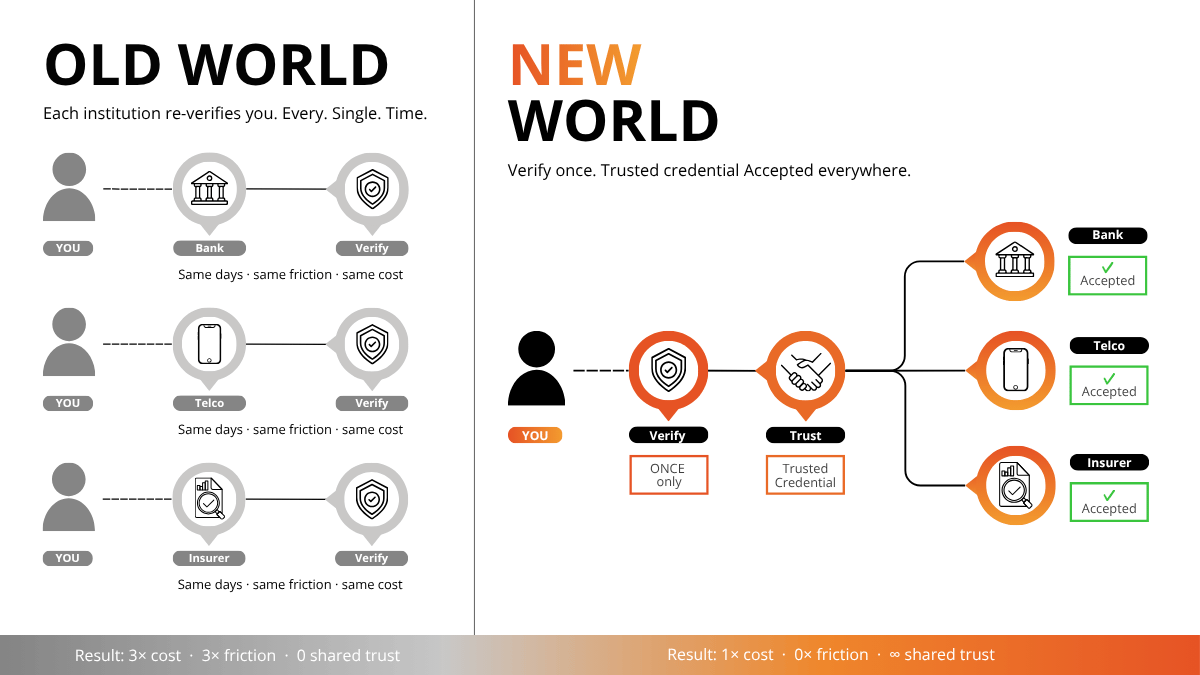
Old-world vs new-world: how verified identity moves – or doesn’t – across institutions.
The shift most boards haven’t noticed yet
What has changed in the last 18 months is not the technology. It is the trust architecture around it. South Africa is beginning to put in place the standards, certifications and trust frameworks that allow a verified digital credential — issued by an authoritative source — to be accepted elsewhere without forcing the customer back to the beginning. The Department of Home Affairs and the South African Reserve Bank are among the institutions already moving in this direction. The regulatory direction is clear — from payments modernisation to digital identity frameworks, the infrastructure is being put in place. The first live demonstrations of how verifiable credentials will operate in South Africa are already happening. This is not a 2030 conversation.
“Once trust becomes portable, a customer no longer has to remain a stranger in every channel and ecosystem.”
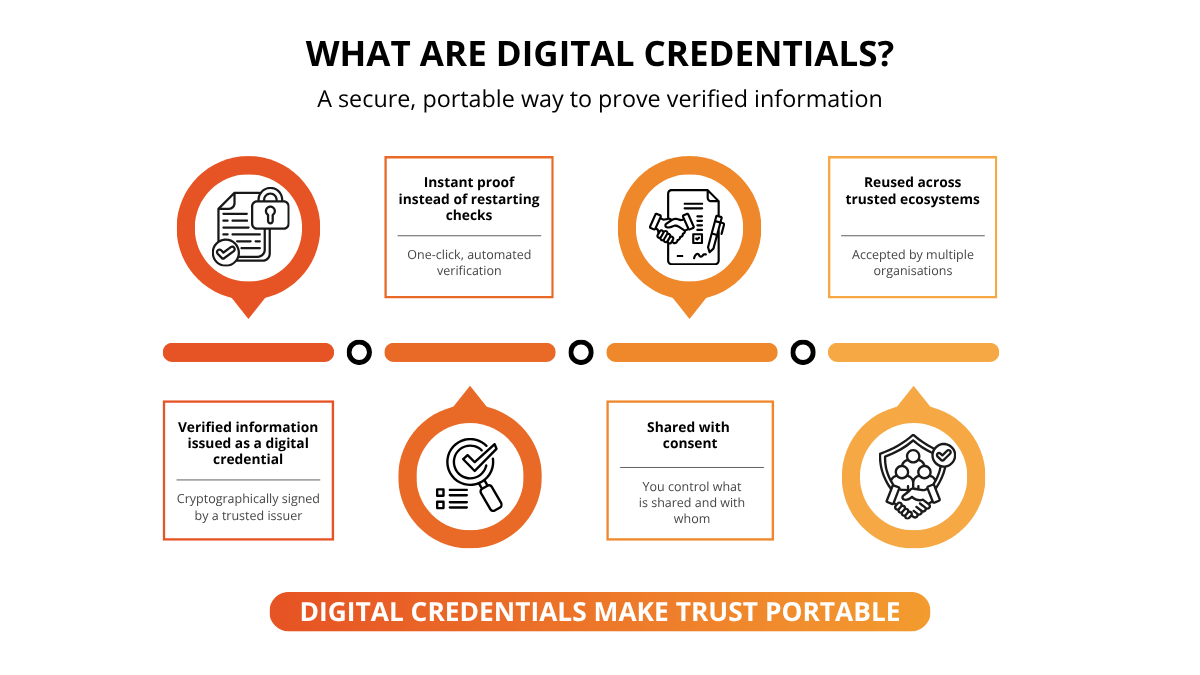
The customer does not re-verify. They present. The institution does not restart the process. It accepts a trusted result and continues the journey.
That is a very different model.
What this means for business – not policy
Think of it this way: a customer who has already verified their identity and has a trusted bank account verification from their bank can present those same verified credentials to their insurer. The insurer verifies the credentials — not the documents. No re-upload. No repeat check. The bank’s trusted verification travels. That is what this infrastructure makes possible.
For leadership teams, the commercial implication is direct.
Businesses begin reducing:
- repeated verification costs
- friction across products and channels, inside and outside the organisation
- delays caused by treating the same customer as new every time context changes
- reduced fraud
This is not digital transformation for digital transformation’s sake. It is about reducing duplicated process, operating costs, conversion drag and building ecosystem growth. That is what is actually at stake.
“Verification is not the endgame. Trust reuse is.”
At Contactable, we’ve been working close to the emerging trust architecture and the practical use cases around it — which is why we see this not as theory, but as an operating shift already beginning. For leadership teams, that should not be filed under “future innovation”. It should be understood for what it is: a new operating layer for digital business.
The real shift is not that South Africa is getting digital credentials. It is that trust itself is starting to move.
It’s the reason I’ve been steering Contactable in this direction. When trust becomes portable, the businesses already built for it won’t be catching up — they’ll be the ones others rely on and customers will choose to engage with.
The businesses moving first are asking these questions
CEO → CTO
“What would it take for us to participate in a national trust framework — as an issuer, a verifier, a technology provider, or some combination?”
COO → Finance
“What are we actually spending on re-verifying the same customer across channels and products? Can someone put a number on it?”
CEO → Strategy
“Are we designing our digital roadmap and customer engagement around the trust layer — or will we be retrofitting in two years?”
Contactable is Africa’s leading Integrated Identity Platform, helping enterprises turn trust into a growth advantage. Through a single integration, we unify identity, compliance and workflow across the customer journey — reducing complexity, strengthening assurance and enabling seamless digital experiences at scale.
Visit contactable.co.za | Follow us on LinkedIn | Facebook